I don't keep up with AI by reading about it. I keep up by building with it: small personal projects where I can pressure-test what's actually possible, then carry the patterns straight back into the work.
The loop I run
Build
Ship a personal project
Pick something real and small, build it end-to-end with the latest tools.
→
Extract
Find the pattern
What got dramatically easier? What's now possible that wasn't last quarter?
→
Apply
Bring it into the work
Use the pattern on a real product problem, with the instincts already earned.
↺ Every application surfaces the next thing worth building.
Hands-on first. By the time a capability matters at work, I've already broken it in on something of my own.
What I'm building
Where I pressure-test
1
This portfolio: a journal that happens to be a website
Built end-to-end with an AI coding agent: the design system, the animated avatar, the case studies distilled from my raw documents. The unexpected part wasn't the velocity. It was the reflection. I'd always wondered how to look back at my own craft; writing decisions into case studies, with an agent asking "what was the trade-off? what did you learn?", turned out to be the journal I never kept. I now understand my own decisions better because I had to narrate them.
2
Morsel: a calorie tracker where the model never invents a fact
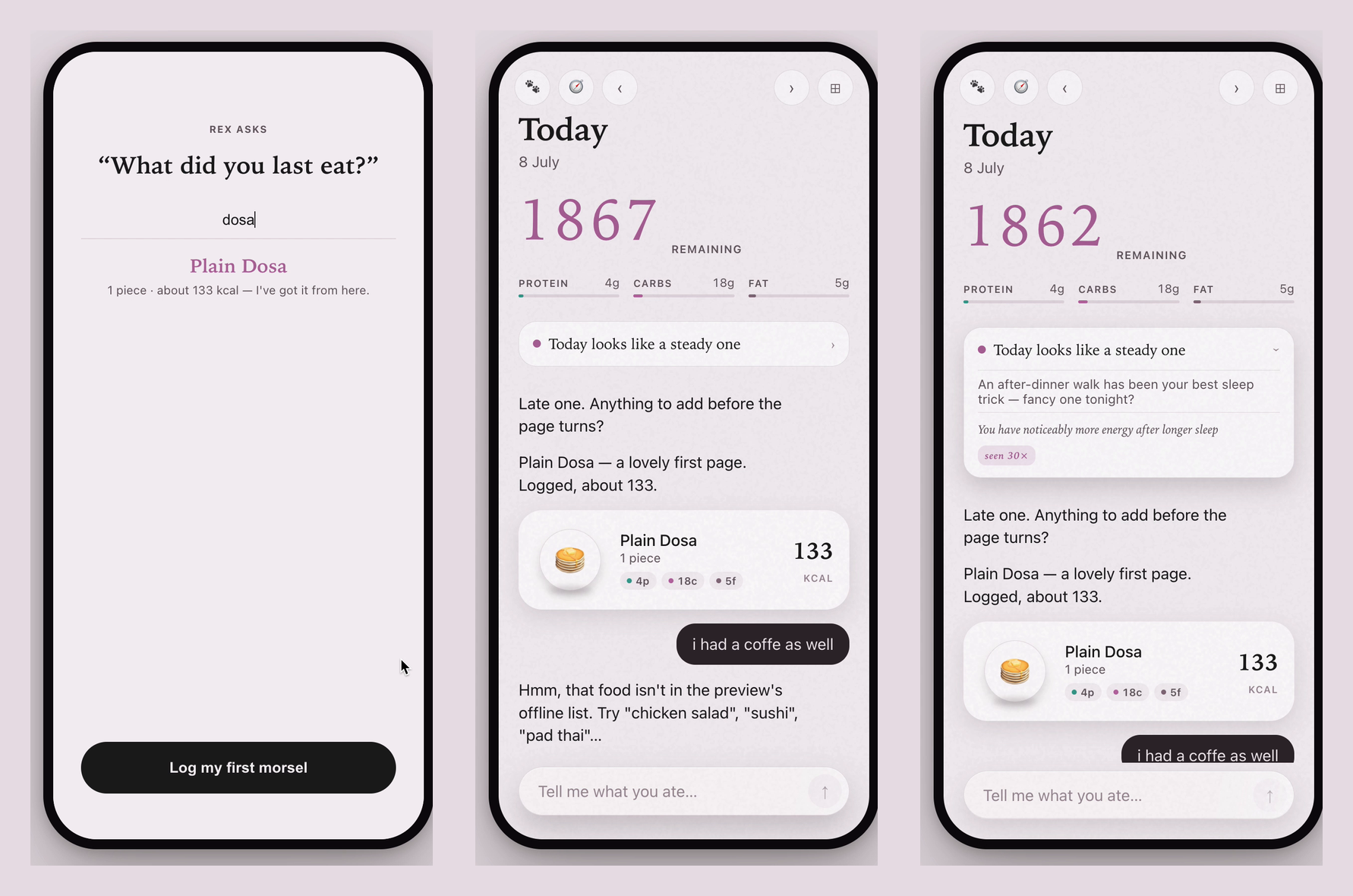
A conversational food-tracking app with a hard rule: the LLM never invents a calorie. Every phrase resolves through a canonical food graph: layered matching (exact → alias → phonetic → fuzzy → semantic), each layer returning a confidence score, every nutrition fact carrying provenance. "Dosa" and "plain dosa" collapse to one food; "masala dosa" deliberately doesn't, because it's ~1.7× the calories. I'm accuracy-checking the model against the graph and building the feedback loop that catches and corrects drift.
Morsel: the food graph behind the conversationLeft to right: "dosa" resolves through the graph to Plain Dosa at 133 kcal; the model logs facts and admits when a food isn't in its list rather than guessing; patterns surface back as gentle, evidenced nudges.
The graph owns the facts; the model only narrates them. Accuracy checks compare what the model says against what the graph knows.
How it feeds back
From side project to shipped product
The clearest example: building hands-on with AI is exactly what made a first PLG-led demo in two months feel routine instead of risky. The instincts were already there; the work just put them to use.
Morsel's core pattern, ground the model in data you own, score its confidence, verify its outputs, and feed corrections back, is exactly how AI belongs in regulated products. It's the same shape as fraud rules tuned for precision, KYC checks with provenance, decisioning with audit trails: trust the system, verify the model. I pressure-tested that architecture on dinner plates so I can argue for it in compliance flows with conviction.